Labels

flac (326) mp3 (324) 16-bit (308) usa (293) 320kbps (233) classical (230) noise (203) jazz (121) italy (75) opera (74) modern classical (72) baroque (71) romanticism (68) chamber music (66) live (60) germany (49) classical period (46) religious (46) collaboration (44) france (43) split (43) japan (39) uk (39) england (38) industrial (37) 2007 (36) austria (36) choral (34) japanoise (32) v0 (32) drone (31) canada (29) country (29) 2018 (27) 2015 (25) 2017 (25) naxos (25) 192kbps (24) 2005 (22) dark ambient (22) nsfw (22) sweden (22) 2012 (21) denmark (21) 1992 (20) 2006 (20) 2010 (20) 2013 (20) 2003 (19) 2008 (19) 2009 (19) compilation (19) power electronics (19) 24-bit (18) folk (17) hyperion (17) 1996 (16) 2011 (16) blues (16) columbia (16) hnw (16) prestige (16) rock (16) 1956 (15) 1995 (15) john wiese (15) czechia (14) finland (14) harmonia mundi (14) russia (14) 1997 (13) art taylor (13) electroacoustic (13) johnny griffin (13) phil blankenship (13) sam mckinlay (13) the rita (13) 1993 (12) 1994 (12) 2000 (12) 2002 (12) 2004 (12) 2014 (12) 2016 (12) 2019 (12) 256kbps (12) ambient (12) harsh noise wall (12) joseph haydn (12) lieder (12) switzerland (12) 1957 (11) 1960 (11) 2001 (11) ballet (11) v2 (11) 128kbps (10) 1972 (10) 1998 (10) brad rose (10) free jazz (10) gospel (10) lhd (10) richard ramirez (10) 1973 (9) 1999 (9) jackie mclean (9) nathan young (9) nicola porpora (9) renaissance (9) 1959 (8) 1961 (8) 1976 (8) 1977 (8) 1978 (8) 1985 (8) 1987 (8) ajilvsga (8) big band (8) chandos (8) contemporary (8) dacapo (8) dave holland (8) emi classics (8) fusion (8) hampton hawes (8) kevin drumm (8) oratorio (8) othmar schoeck (8) pain jerk (8) paul chambers (8) richard wagner (8) sun ra (8) vomir (8) 1958 (7) 1967 (7) 1968 (7) 1969 (7) 1971 (7) 1974 (7) 1979 (7) 1986 (7) 1988 (7) 1989 (7) aaron dilloway (7) andreas staier (7) belgium (7) bis (7) carl nielsen (7) donald byrd (7) ecm (7) frank morgan (7) hank mobley (7) igor stravinsky (7) jack dejohnette (7) jenő jandó (7) kenny drew (7) knurl (7) macronympha (7) pop (7) rca (7) 1962 (6) 1964 (6) american primitive (6) brilliant classics (6) christoph willibald gluck (6) deutsche grammophon (6) doug watkins (6) duke ellington (6) eddie "lockjaw" davis (6) erato (6) francesco cavalli (6) giacinto scelsi (6) glossa (6) jan ladislav dussek (6) johann adolf hasse (6) johann sebastian bach (6) john gilmore (6) louis hayes (6) marc-antoine charpentier (6) norway (6) per nørgård (6) self abuse (6) self-released (6) sonny stitt (6) 1955 (5) 1963 (5) 1970 (5) 1982 (5) 1991 (5) 2020 (5) 224kbps (5) andré grétry (5) billy higgins (5) blue note (5) carl ditters von dittersdorf (5) chick corea (5) cpo (5) free folk (5) government alpha (5) incapacitants (5) maria callas (5) mikko aspa (5) moodsville (5) new jazz (5) niels-henning ørsted pedersen (5) pure (5) red garland (5) richard strauss (5) riverside (5) toshiji mikawa (5) troniks (5) vocal jazz (5) yusef lateef (5) 1951 (4) 1952 (4) 1965 (4) 1980 (4) 1981 (4) 4ib (4) alexander scriabin (4) antonio lotti (4) atlantic (4) barry harris (4) ben riley (4) blue sabbath black cheer (4) bob dylan (4) charles mingus (4) charles wuorinen (4) china (4) cracksteel (4) dan johansson (4) decca (4) deterge (4) dexter gordon (4) emil beaulieau (4) erstwhile (4) field recordings (4) franz schubert (4) freak animal (4) gene ammons (4) haare (4) hanson (4) heavy psych (4) herbert howells (4) hip-hop (4) impressionism (4) jazzland (4) jim haras (4) johan svendsen (4) jon borges (4) junior mance (4) kenny clarke (4) kenny wheeler (4) kungliga filharmonikerna (4) larry gales (4) mal waldron (4) marshall allen (4) mercury (4) miles davis (4) mosaic (4) mo・te (4) msbr (4) ominous recordings (4) orchester der bayreuther festspiele (4) orchestra del teatro alla scala (4) oslo-filharmonien (4) patrick o'neil (4) philharmonia orchestra (4) rrrecords (4) sakari oramo (4) sam jones (4) team boro tapes (4) tullio serafin (4) verve (4) vincenzo bellini (4) virgin classics (4) warner classics (4) wilhelm stenhammar (4) william shakespeare (4) 1954 (3) 1975 (3) abisko (3) airto moreira (3) alban berg (3) antonio caldara (3) balthasar-neumann-chor (3) barney kessel (3) black leather jesus (3) bootleg (3) buzz freeman (3) cedar walton (3) charlie haden (3) chess (3) chondritic sound (3) christoph prégardien (3) christophe rousset (3) cipher productions (3) cti (3) debut (3) dietrich fischer-dieskau (3) digitalis recordings (3) doom (3) dynamic (3) ecm new series (3) elmo hope (3) elvin jones (3) erik nystrand (3) estonia (3) fumio kosakai (3) genesis (3) genoasejlet (3) georg friedrich händel (3) george enescu (3) george jones (3) giacomo carissimi (3) giovanni legrenzi (3) giovanni pierluigi da palestrina (3) girolamo frescobaldi (3) glenn gould (3) grunt (3) herbie hancock (3) hospital productions (3) howard shelley (3) hungaroton (3) internazionale (3) janushoved (3) jason lescalleet (3) jean-philippe rameau (3) jim hall (3) joe farrell (3) johann baptist vanhal (3) john coltrane (3) john olson (3) johnny cash (3) julianne baird (3) kaija saariaho (3) latin (3) les arts florissants (3) les talens lyriques (3) marcia bassett (3) mario venzago (3) maurizio bianchi (3) new age (3) new forces (3) ottorino respighi (3) pain nail (3) phil collins (3) philips classics (3) philly joe jones (3) progressive rock (3) r&b (3) ray brown (3) red mitchell (3) robbie basho (3) romania (3) sam rivers (3) shelly manne (3) skin crime (3) solipsism (3) sony classical (3) spoken (3) the gift of music (3) the new blockaders (3) the parley of instruments (3) thomas hengelbrock (3) tommy flanagan (3) torturing nurse (3) tourette (3) urashima (3) vasculae (3) veljo tormis (3) walter bishop jr. (3) wardell gray (3) wiener philharmoniker (3) william christie (3) willie nelson (3) 1928 (2) 1941 (2) 1942 (2) 1948 (2) 1953 (2) 1990 (2) academy of st. martin-in-the-fields (2) alex riel (2) alfred schnittke (2) amp (2) antonio de almeida (2) anw (2) aparté (2) arcana (2) archiv produktion (2) armenia (2) art blakey (2) art farmer (2) art pepper (2) arthur phipps (2) atma classique (2) bacillus (2) bacteria field (2) balthasar-neumann-ensemble (2) benny carter (2) berliner philharmoniker (2) bill hardman (2) billie holiday (2) bizarre audio arts (2) blind lemon jefferson (2) blue mitchell (2) bob dylan & the band (2) brigitte fassbaender (2) bruno maderna (2) buell neidlinger (2) buster williams (2) camesina quartet (2) capitol (2) cecil mcbee (2) chant (2) charisma (2) charles valentin alkan (2) chris goudreau (2) claudio cavina (2) col legno (2) concord jazz (2) craig taborn (2) curtis fuller (2) das alte werk (2) david allan coe (2) deathbed tapes (2) denshi zatsuon (2) der ring (2) dial square tapes (2) dick griffin (2) document (2) dominick fernow (2) doug sides (2) droughter (2) ebm (2) edgar doneux (2) el saturn (2) electronic (2) electronica (2) epic (2) ernie farrow (2) fecalove (2) fusty cunt (2) gary bartz (2) gelsomina (2) george cables (2) george proctor (2) gerd albrecht (2) gian francesco malipiero (2) gioacchino rossini (2) giovanni maria trabaci (2) gnarled forest (2) goat (2) greh holder (2) göteborgs symfoniker (2) hank williams (2) harbinger sound (2) hard bop (2) harry partch (2) heinz holliger (2) heinz hopf (2) helicopter (2) henry purcell (2) herbert von karajan (2) hhl (2) hive mind (2) hong chulki (2) hong kong (2) hong kong philharmonic orchestra (2) hugh lawson (2) ignaz joseph pleyel (2) improvised (2) in slaughter natives (2) incidental music (2) india (2) ireland (2) island (2) jaap van zweden (2) jack rose (2) jason crumer (2) jean-baptiste lully (2) jean-joseph cassanéa de mondonville (2) jean-paul fouchécourt (2) jimmy rowles (2) jimmy woode (2) johann nepomuk hummel (2) johann pachelbel (2) johannes brahms (2) john mclaughlin (2) john neschling (2) john prine (2) john storgårds (2) josé van dam (2) julian priester (2) k2 (2) kai wessel (2) kaikhosru shapurji sorabji (2) karl böhm (2) keith brewer (2) keith jarrett (2) kenny dorham (2) la venexiana (2) lake shark harsh noise (2) legless (2) leonardo leo (2) leoš janáček (2) leroy vinnegar (2) les musiciens du louvre (2) lex humphries (2) liberty uganda (2) mania (2) marc minkowski (2) marco polo (2) mario filippeschi (2) mariss jansons (2) marjana lipošek (2) marty krystall (2) matthew gee (2) max emanuel cencic (2) mdg (2) medieval (2) michelle deyoung (2) mmb (2) mnem (2) mode (2) modern harmonic (2) monique zanetti (2) montserrat caballé (2) mother savage noise productions (2) mutant ape (2) muzio clementi (2) n. (2) new london chamber choir (2) nicola rossi-lemeni (2) nicola vinciguerra (2) nicolai gedda (2) olympisk løft (2) ondine (2) opera d'oro (2) opus arte (2) orchestra del maggio musicale fiorentino (2) orchestra of the antipodes (2) orchestra of the metropolitan opera (2) orchestre de la rtb (2) orf radio-symphonieorchester wien (2) orfeo (2) ornette coleman (2) oscar peterson (2) pan classics (2) peter holman (2) philips (2) pinchgut live (2) praga digitals (2) prairie fire (2) prurient (2) ray bryant (2) richard egarr (2) richard tucker (2) richie kamuca (2) robedoor (2) rundfunkchor leipzig (2) ryan bloomer (2) scorpio (2) scotland (2) segerhuva (2) sergio vartolo (2) sewer election (2) sharon's last party (2) she walks crooked (2) sick llama (2) skin graft (2) slaughter productions (2) slugs' saloon (2) sonny rollins (2) soul jazz (2) south korea (2) squamata (2) staatskapelle dresden (2) steeplechase (2) stefano aresi (2) stephen layton (2) steve coleman (2) stile galante (2) strata-east (2) symphonieorchester des bayerischen rundfunks (2) tapeworm tapes (2) techno (2) telarc (2) teldec (2) tetsuo furudate (2) the band (2) the basement tapes (2) the north sea (2) the young danish string quartet (2) thelonious monk (2) tommy potter (2) trash ritual (2) treriksröset (2) tribute (2) troum (2) two assistant deputy ministers (2) tzadik (2) v1 (2) vanguard (2) vanity productions (2) varg (2) werewolf jerusalem (2) white gold (2) wilbur ware (2) wolfgang amadeus mozart (2) worthless recordings (2) wynton kelly (2) xerxes (2) yazoo (2) zaïmph (2) zwangsbelgucktertum (2) âmes sanglantes (2) 16 shots per second (1) 160kbps (1) 1917 (1) 1926 (1) 1927 (1) 1929 (1) 1930 (1) 1931 (1) 1933 (1) 1935 (1) 1936 (1) 1937 (1) 1940 (1) 1943 (1) 1947 (1) 1950 (1) 1966 (1) 1983 (1) 1984 (1) 23 productions (1) 26 volts of danger recordings (1) a raja's mesh men (1) a&m (1) a.l. lloyd (1) a.z.a.b. (1) aam (1) abandon ship (1) academy of ancient music (1) accord (1) adam riis (1) addison farmer (1) adriano (1) adriano maria fazio (1) adrienne soós (1) agnes baltsa (1) agression sonore (1) alain lombard (1) alan curtis (1) alan feinberg (1) albany (1) albert ammons (1) albert ayler (1) albert heath (1) alchemy (1) aleksandar nenad (1) alexander weimann (1) alexei lubimov (1) alfarmania (1) allyson mchardy (1) alms (1) alpha classics (1) amandine beyer (1) ambrosian opera chorus (1) american composers orchestra (1) american tapes (1) amos trice (1) an innocent young throat-cutter (1) anarchofreaksproduction (1) andrea coen (1) andrea stadel (1) andreas karasiak (1) andrew goodwin (1) andris nelsons (1) andrius zlabys (1) andré anichanov (1) angst (1) anna moffo (1) anna tomowa-sintow (1) annette dasch (1) annette krebs (1) anselmo colzani (1) anssi karttunen (1) antal dorati (1) anthony korf (1) anthony walker (1) antilles (1) antoine brumel (1) antonino votto (1) antonio de cabazón (1) antonio figueroa (1) antonio salieri (1) antonín dvořák (1) apple (1) aradia ensemble (1) arianna art ensemble (1) arion (1) arkiv produktion (1) arne deforce (1) arnold schönberg (1) ars produktion (1) art konkret (1) art yard (1) arthur honegger (1) artifizii musicali (1) artists house (1) artur bodanzky (1) ash international (1) asylum (1) atma baroque (1) aube (1) audiobot (1) aurora orchestra (1) auser musici (1) australia (1) autrement qu'être (1) avanti! chamber orchestra (1) avery sharpe (1) axel kober (1) backasvinet (1) barbatos productions (1) barrikad (1) bascom lamar lunsford (1) bastiaan blomhert (1) batzdorfer hofkapelle (1) bayer (1) bbc legends (1) bbc philharmonic (1) bbc scottish symphony orchestra (1) bbc symphony orchestra (1) benjamin britten (1) bennie maupin (1) benny bailey (1) berlin classics (1) berliner symphoniker (1) bernard deletré (1) berner symphonieorchester (1) big bill broonzy (1) big hole (1) bill connors (1) bill evans (1) billy cobham (1) billy osbourne (1) billy strayhorn (1) birth refusal (1) bizarre uproar (1) bjarte engeset (1) black lion (1) black matter phantasm (1) black ring rituals (1) black saint (1) blind blake (1) blind boy fuller (1) blind willie johnson (1) blind willie mctell (1) blod (1) blossoming noise (1) blue cheer (1) bluebird (1) boaz sharon (1) bocksholm (1) bohdan warchal (1) bongiovanni (1) br-klassik (1) bradíc (1) breathing problem (1) breathing problem productions (1) brenton banks (1) brewer chamber orchestra (1) brise-cul (1) broken flag (1) bruno cocset (1) bruno gini (1) bruno procopio (1) bud powell (1) budapesti madrigálkórus (1) buddah (1) buddy montgomery (1) c. lavender (1) c.l. smooth (1) cajun (1) caligula031 (1) call cobbs jr. (1) callow god (1) camerata bern (1) camerata schweiz (1) camilla nylund (1) canary (1) cantillation (1) cantus classics (1) cappella coloniensis (1) cappella musicale pontificia sistina (1) capriccio (1) caprice (1) carl heinrich graun (1) carl smith (1) carlo ipata (1) carlos giffoni (1) carnegie melon philharmonic (1) carus (1) catherine bott (1) celeste lazarenko (1) celluloid murder (1) centaur (1) chaconne (1) challenge classics (1) chamber orchestra i tempi (1) charles gounod (1) charles koechlin (1) charles moffett (1) charles tolliver (1) charlie persip (1) charlie rice (1) charlie rich (1) chloroform rapist (1) choeur de chambre de namur (1) choir of aam (1) choir of trinity college cambridge (1) chris laurence (1) christian gerhaher (1) christian nicolay (1) christian stadsgaard (1) christiane eda-pierre (1) christoph croisé (1) christophe dumaux (1) christopher jackson (1) christopher moulds (1) christopher robson (1) christophorus (1) chœurs de la rtb (1) cinquecento (1) city of london sinfonia (1) clarius audi (1) clark terry (1) claudette leblanc (1) claves (1) clef (1) clifford jordan (1) cloama (1) cold meat industry (1) come organisation (1) complesso pro musica firenze (1) composers recordings inc. (1) concentus vocalis (1) concerto köln (1) concerto vocale (1) concrete mascara (1) condo horro (1) connie kay (1) consortium carissimi (1) contagious orgasm (1) conte candoli (1) conway twitty (1) cori spezzati (1) coro claudio monteverdi (1) coro della radiotelevisione svizzera (1) crd (1) cremation lily (1) crimes of the crown (1) cruel nature (1) curtis lundy (1) cyclic law (1) d.a.c. (1) daniel sepec (1) daniel szeili (1) daniela dolci (1) danilo serraiocco (1) dannie richmond (1) danny ray thompson (1) dante quartet (1) dare2 (1) dave frishberg (1) david adams (1) david bates (1) david izenzon (1) dawn upshaw (1) dead birds (1) dead body collection (1) deadline recordings (1) death industrial (1) desolation house (1) deutsche kammerakademie (1) deutsches symphonie-orchester berlin (1) diana montague (1) diego fasolis (1) dieter klöcker (1) dino valente (1) discipline (1) disques pierre verany (1) dizzy gillespie (1) dizzy reece (1) dj premier (1) dmitri shostakovich (1) doc bagby (1) dolce & tempesta (1) don alias (1) don byas (1) don cherry (1) don gibson (1) don patterson (1) donald bailey (1) dorian keilhack (1) dorothee oberlinger (1) dosis letalis (1) double leopards (1) douglas ahlstedt (1) dr koncertkoret (1) dr vokalensemblet (1) dresdner kapellknaben (1) drew minter (1) dried up corpse (1) drinkluder (1) duke jordan (1) dusa (1) dust-to-digital (1) dwight yoakam (1) ebe stignani (1) eberhard weber (1) ebony-duo (1) eckhart hübner (1) eclipse (1) ed lyon (1) eddie gale (1) eddie gomez (1) edgard varèse (1) editions de l'oiseau lyre (1) editions mego (1) edvard grieg (1) edward brewer (1) edward vesala (1) eesti filharmoonia kammerkoor (1) einojuhani rautavaara (1) eje thelin (1) elbogen fonogram (1) eleczema (1) elektra (1) elena cecchi fedi (1) elisabeth rethberg (1) elisabeth schwarzkopf (1) elizabeth calleo (1) elizabeth farnum (1) elsa benoit (1) elvis presley (1) emaciator (1) emeralds (1) emil richards (1) emiliano gonzalez toro (1) emmanuel pahud (1) emmylou harris (1) endymion ensemble (1) enemata productions (1) english bach festival baroque orchestra (1) ensemble elyma (1) ensemble für frühe musik augsburg (1) ensemble la pifarescha (1) ensemble legrenzi (1) ensemble modern orchestra (1) ensemble olivier opdebeeck (1) ensemble seicentonovecento (1) ensemble vocal françoise herr (1) epoca baroca (1) erasmo ghiglia (1) erdódy chamber orchestra (1) eric harland (1) erin headley (1) erin helyard (1) ernst ottensamer (1) esa-pekka salonen (1) esp-disk (1) et'cetera (1) ethnic (1) evan parker (1) evelyn lear (1) evgeny kissin (1) evil moisture (1) ewan maccoll (1) experiments in american music (1) fabienne jost (1) fag tapes (1) failing lights (1) failoni orchestra (1) fall into void recs (1) fausto cleva (1) fedora barbieri (1) ferenc szekeres (1) ffrr (1) filippo piccolo (1) fingering eve (1) finlandia (1) flatline construct (1) flavio colusso (1) fonation orange (1) forced orgasm (1) fort evil fruit (1) francesco albanese (1) francesco cera (1) franck-emmanuel comte (1) franco fagioli (1) francy boland (1) franz berwald (1) franz schuber (1) françois devienne (1) françois-xavier roth (1) freckle (1) fred jordan (1) fred neil (1) freddie waits (1) frederico maria sardelli (1) fredrik malmberg (1) freiburger barockorchester (1) fresh sound (1) friedrich schorr (1) frits celis (1) fromental halévy (1) frédéric chopin (1) fuga libera (1) further (1) g.t. hogan (1) gabriel garrido (1) galactique (1) gambit (1) gameboy (1) gary bertini (1) gary cooper (1) gaudeamus (1) gennady rozhdestvensky (1) genuin (1) georg philipp telemann (1) george joyner (1) george onslow (1) george wadenius (1) george zeppenfeld (1) gerald finzi (1) gerhard müller-hornbach (1) gevorg gharabekyan (1) gianandrea noseda (1) gidon kremer (1) gil coggins (1) gil scott-heron (1) gilles de rais order (1) giovanni battista costanzi (1) giovanni guglielmo (1) giovanni sollima (1) gipsy sphinx (1) giuseppe di stefano (1) giuseppe modesti (1) giuseppe valengo (1) giuseppe verdi (1) giuseppina bridelli (1) gli incogniti (1) glistening examples (1) gnp (1) goaty tapes (1) golden years of new jazz (1) gomikawa fumio (1) gordon wilson ashworth (1) gould piano trio (1) graham pushee (1) grant green (1) great opera performances (1) gremlynz (1) grkzgl (1) guild (1) guilty connector (1) gun-brit barkmin (1) gunnar graarud (1) guy clark (1) guy delvaux (1) gächinger kantorei stuttgart (1) gérard lesne (1) hadleigh adams (1) hal hutchinson (1) hanged mans orgasm (1) hank jones (1) hans hotter (1) hans-christoph rademann (1) hanspeter gmür (1) harald stamm (1) harold land (1) harry edison (1) harry james (1) harshnoise (1) hat art (1) heavy tapes (1) hebi like a snake (1) helen humes (1) helene gjerris (1) helga dernesch (1) helios (1) helmut walcha (1) henning voss (1) henry grimes (1) herb ellis (1) herbert kegel (1) herbie lewis (1) heretic grail (1) hermann wright (1) hervé niquet (1) hidemi suzuki (1) highnote (1) hilton ruiz (1) hologram label (1) holst singers (1) horace arnold (1) horace parlan (1) horace silver (1) howard griffiths (1) howard mcghee (1) howlin' wolf (1) hubert laws (1) hubert wild (1) huff raid robot (1) hugh ragin (1) hugh schick (1) human larvae (1) hungary (1) håkan hagegård (1) ian partridge (1) iatrogenesis (1) ideal recordings (1) ides recordings (1) idiopathic (1) idris muhammad (1) iestyn davies (1) igor markevitch (1) ike turner (1) il complesso barocco (1) il fondamento (1) il pomo d'oro (1) ilan volkov (1) impregnable (1) impulse! (1) inhalant (1) inhos (1) inner city (1) innova recordings (1) institut (1) institute of paraphilia studies (1) interior one (1) irmgard seefried (1) isabelle van keulen (1) israel (1) istván várdai (1) ivo haag (1) ivor gurney (1) j.j. johnson (1) jaakko vanhala (1) jack sheldon (1) jaco pastorius (1) jaki byard (1) jamaica (1) james blackshaw (1) james ehnes (1) james lockhart (1) james wood (1) jan dismas zelenka (1) jan garbarek (1) jane getz (1) jaribu shihad (1) jarl (1) jaro prohaska (1) jason "evil" covelli (1) jazz:west (1) jean-françois gardeil (1) jean-françois jenny-clark (1) jean-jacques rousseau (1) jeff witscher (1) jeffrey thompson (1) jeru the damaja (1) jessye norman (1) jetset (1) jimmy bond (1) jimmy forrest (1) jimmy heath (1) jimmy yancey (1) joe gordon (1) joe guy (1) joe henderson (1) joe mondragon (1) joe pass (1) joe turner (1) joe zawinul (1) johannes goritzki (1) johannes kalitzke (1) johannes wildner (1) john bull (1) john eliot gardiner (1) john fahey (1) john handy (1) john kurnick (1) john ore (1) john parricelli (1) john simmons (1) john taylor (1) john witfield (1) jon christensen (1) joni mitchell (1) josef greindl (1) joseph robichaux (1) josé carreras (1) joyce didonato (1) juan pablo izquierdo (1) judith bettina (1) judith bingham (1) judith pannill (1) jukka tiensuu (1) jukka-pekka saraste (1) julia varady (1) june anderson (1) june tyson (1) järtecknet (1) jérôme corres (1) jörg waschinski (1) jürg henneberger (1) k2b2 (1) kadaver (1) kakerlak (1) kammerchor heidelburg (1) kaos kontrol (1) karen dalton (1) karin branzell (1) karl elmendorff (1) karl engel (1) karl schmidt verlag (1) katarina (1) kathryn scott (1) kein & aber (1) kenny barron (1) kenny burrell (1) kenny dennis (1) kent nagano (1) keranen (1) keränen (1) kevin eubanks (1) kickacid (1) kikanju baku (1) kim kashkashian (1) kinky music institute (1) kiri te kanawa (1) kirill gerstein (1) kirill kondrashin (1) klanggalerie (1) klaus florian vogt (1) klaus merterns (1) knabenchantorei basel (1) konrad wagner (1) koryphaia (1) krautrock (1) kremerata baltica (1) kris kristofferson (1) kurt eichhorn (1) la nuova musica (1) la stagione armonica (1) larry bunker (1) last rape (1) laura heimes (1) lawo classics (1) lawrence marable (1) le concert de l'hostel dieu (1) le concert spirituel (1) le nouvel opéra (1) lee konitz (1) lee morgan (1) leibstandarte ss mb (1) leo (1) leonardo vinci (1) lera auerbach (1) leroy williams (1) les basses réunies (1) les disques du soleil et de l'acier (1) les paladins (1) less than zero (1) lew tabackin (1) lewis nash (1) liberty (1) linda mccartney (1) linda perillo (1) lionel hampton (1) lionel rogg (1) liszt ferenc kamarazenekar (1) lloyd mayers (1) london mozart players (1) london sinfonietta (1) london symphony orchestra (1) lone star (1) lorenzo coppola (1) lorraine hunt (1) lost light (1) love earth music (1) lucine amara (1) ludwig august lebrun (1) luigi dallapiccola (1) luke huisman (1) luqman ali (1) lusine zakaryan (1) luzzasco luzzaschi (1) lyrichord (1) m4a (1) mackenzie chami (1) mads vinding (1) mady mesplé (1) mahan esfahani (1) maim (1) mainstream (1) makoto akatsu (1) malcolm proud (1) malcolm stewart (1) mara zampieri (1) marc-andré hamelin (1) marcello lippi (1) marco deplano (1) marcus creed (1) margaret kampmeier (1) margrit weber (1) marguerite krull (1) maria bayo (1) maria müller (1) marianne schroeder (1) marie-adeline henry (1) marin alsop (1) mark durgan (1) mark kozelek (1) mark padmore (1) martial solal (1) martin france (1) martin gabriel (1) martin haselböck (1) martin sturfält (1) martyn hill (1) marvin "smitty" smith (1) maría bayo (1) mass ornament (1) massimo palombella (1) masumi nagasawa (1) mats widlund (1) matthias goerne (1) matthias jung (1) max lorenz (1) maxim emelyanychev (1) mccoy tyner (1) meade "lux" lewis (1) medusa (1) melodiya (1) menstrualrecordings (1) merle haggard (1) merzbow (1) metal (1) mgb (1) michael mcdonald (1) michel plasson (1) michèle dévérité (1) miisc (1) mike connelly (1) mike mainieri (1) milestone (1) military (1) misanthropic agenda (1) mlehst (1) moisture discipline (1) mondo musica (1) monica bacelli (1) monica piccinini (1) monika leskovar (1) monk montgomery (1) monteverdi choir (1) moscow philharmonic orchestra (1) moscow symphony orchestra (1) motette (1) mps (1) msi (1) muse (1) musica alta ripa (1) musica fiorita (1) musica omnia (1) mutare ensemble (1) muzikaal kabaal (1) myto (1) münchner rundfunkorchester (1) nancy hadden (1) nanny larsen-todsen (1) nat adderley (1) ncfo (1) near passerine devotionals (1) nectroik fissure (1) neeme järvi (1) neil varon (1) nepomuk fortepiano quintet (1) netherlands (1) neville marriner (1) new brutalism (1) new chamber opera (1) new world (1) newport classic (1) nfw (1) nicholas mcgegan (1) nick drake (1) nicola fiorenza (1) nicola monti (1) niellerade fallibilisthorstar (1) nigel short (1) nihilist commando (1) nikolai myaskovsky (1) nino sanzogno (1) no fun productions (1) no rent (1) nonesuch (1) norfolk trotter (1) norman simmons (1) novus (1) nuovo era (1) nurse etiquette (1) objective/subjective (1) ochu (1) octa (1) okeh (1) olaf bär (1) old hat (1) ole kristian ruud (1) oliver knussen (1) olivier messiaen (1) olivier opdebeeck (1) onzy matthews (1) opera lafayette orchestra (1) opus 111 (1) orchester der deutschen oper berlin (1) orchestra 'van wasenaer' (1) orchestra del teatro la fenice (1) orchestra di milano della rai (1) orchestra leonardo leo (1) orchestre de l'opéra de lyon (1) orchestre de l'opéra de paris (1) orchestre de louis de froment (1) orchestre du capitole de toulouse (1) orchestre philharmonique de monte-carlo (1) orchestre philharmonique de strasbourg (1) orchestre philharmonique royal de liège (1) organ (1) orquestra sinfônica do estado de são paulo (1) oscillating innards (1) oslo philharmonic wind soloists (1) otoroku (1) oubliette (1) p-tapes (1) p.e. (1) pablo bruna (1) pacrec (1) panta rhei (1) parnassus ensemble (1) parnasus symphonicus (1) patrice djerejian (1) patricia johnson (1) patricia petibon (1) patricia spence (1) patrizia zanardi (1) patsy cline (1) paul bryant (1) paul dombrecht (1) paul mccartney (1) paul motian (1) pauline vaillancourt (1) pavel kolesnikov (1) payday (1) peasant magik (1) pedro de araujo (1) peking crash team (1) pekka perä-takala (1) pelt (1) pentatone (1) percussive rotterdam (1) percy heath (1) perpetual abjection (1) pete johnson (1) pete rock (1) pete rock & c.l. smooth (1) peter erskine (1) peter gabriel (1) peter jablonski (1) peter reichert (1) peter rundel (1) peter watchorn (1) philharmonische werkstatt schweiz (1) philippe jaroussky (1) philippe pierlot (1) philly jazz (1) phurpa (1) piano classics (1) pietro bosna (1) plácido domingo (1) poland (1) pollutive static (1) polydor (1) porn noise (1) portugal (1) praxis dr. bearmann (1) propergol (1) propulsive audio (1) puce mary (1) puerto rico (1) putrefier (1) párkányí quartet (1) péter szabó (1) quack quack (1) quatuor molinari (1) radio sinfoniaorkesteri (1) ralph moore (1) ralph vaughan williams (1) rap-a-lot (1) raubbau (1) ray draper (1) ray drummond (1) red callender (1) redsk (1) reggae (1) reinhold gliere (1) renata rusche (1) rene maison (1) rené jacobs (1) reprise (1) rev. gary davis (1) rias kammerchor (1) ricercar (1) ricercar consort (1) richard hickox (1) richard russell (1) richard williams (1) rinaldo alessandrini (1) rita coolidge (1) rita streich (1) robert craft (1) robert crumb (1) robert kerns (1) robin johannsen (1) rodney crowell (1) rodney kendrick (1) roel dieltiens (1) rogueart (1) roland bufkens (1) roland hanna (1) rolando panerai (1) romantcism (1) romina basso (1) ron carter (1) roost (1) rosamunde quartett (1) roscoe mitchell (1) rossella ragatzu (1) roy goodman (1) roy hargrove (1) roy haynes (1) royal liverpool philharmonic orchestra (1) royal scottish national orchestra (1) rrr (1) rudolf schock (1) rudolph palmer (1) ruggero leoncavallo (1) rundfunk-sinfonieorchester leipzig (1) rundfunkchor berlin (1) russ freeman (1) ryan brown (1) ryu hankil (1) sabine meyer (1) sacred harp (1) sahib shihab (1) sam larner (1) samuel barber (1) sandra arnold (1) sarah makem (1) satan's din (1) saturn research (1) saverio mercadante (1) savoy (1) schakalens bror (1) scott lafaro (1) scum yr earth (1) sebastian tewinkel (1) sebatián aguilera de heredia (1) seicento (1) seiji ozawa (1) serbia (1) serge baudo (1) sergey pakhomov (1) seven sermones ad mortuos (1) sharon quartet (1) sharpwaist (1) sick seed (1) siege electronics (1) signum classics (1) simon joy chorale (1) simon keenlyside (1) simon rattle (1) sinner lady gloria (1) sissisters (1) sixes (1) skeleton dust recordings (1) skin area (1) skip james (1) slave chandelier (1) slide hampton (1) slovenský komorný orchester (1) snuff (1) solid state (1) soloists of the cappella musicale di s. petronio di bologna (1) sonia prina (1) sonnenrad (1) sonny clark (1) sophie bevan (1) soul (1) soul note (1) sound & fury (1) soup (1) spain (1) spine scavenger (1) spite (1) spykes (1) st. petersburg state symphony orchestra (1) staatsorchester rheinische philharmonie (1) stadttheater bern (1) stan sulzamnn (1) stanley clarke (1) stanley cowell (1) steel hook prostheses (1) stefan parkman (1) stefan östersjo (1) stefano demicheli (1) steffen kubach (1) stegm (1) stenhammar quartet (1) stepan turnovsky (1) stephanie mccallum (1) stephen alltop (1) stephen hough (1) stephen rice (1) sterile (1) steve earle (1) steve ellington (1) steve goodman (1) steve osborne (1) stimbox (1) strict (1) studio de musique ancienne de montréal (1) sun kil moon (1) sunny murray (1) support unit (1) survivalist (1) suzie leblanc (1) swampland (1) symonický orchester slovenského rozhlasu (1) symphonieorchester des orf (1) symphony orchestra of vlaamse opera (1) synthpop (1) s·core (1) sächsisches vocalensemble (1) sønderjyllands symfoniorkester (1) südwestdeutsches kammerorchester pforzheim (1) takoma (1) taku unami (1) tall poppies (1) tani tabbal (1) tape room (1) tape tektoniks (1) tapiolan kamarikuoro (1) taskmaster (1) teddy charles (1) teddy stewart (1) teddy wilson (1) tenebrae (1) tension collapse (1) terror cell unit (1) the brabant ensemble (1) the cherry point (1) the copper family (1) the doobie brothers (1) the king's consort (1) the level of vulnerability (1) the london haydn quartet (1) the percussive planet ensemble (1) the queen's chamber band (1) the voice of the people (1) the vomit arsonist (1) theo adam (1) theorema (1) thomas arne (1) thomas füri (1) thomas hayward (1) thrill jockey (1) tibet (1) tibetan monks (1) tim frederiksen (1) tim hardin (1) tito gobbi (1) tom krause (1) tom t. hall (1) tom van der geld (1) tom waits (1) tommy bryant (1) tony dumas (1) topic (1) torsten kerl (1) toshiko akiyoshi (1) total black (1) total zero (1) tower voices new zealand (1) tradition (1) train cemetery (1) transition (1) transparency (1) trashfuck (1) trauma tone recordings (1) triangle (1) troglosound (1) trojan (1) trondheim symfoniorkester (1) troubleman unlimited (1) trudelise schimdt (1) trummy young (1) turgid animal (1) turkey (1) tyshawn sorey (1) tõnu kaljuste (1) tøke moldrup (1) ukraine (1) ulf bästlein (1) ulf schirmer (1) uncle dave macon (1) unclean (1) united artists (1) united forces of industrial (1) utmarken (1) utsu tapes (1) uwe grodd (1) uzusounds (1) vadym kholodenko (1) valois (1) vanguard productions (1) vasily petrenko (1) vee-jay (1) venezuela (1) vern gosdin (1) vernon handley (1) verve forecast (1) vhf (1) victor sproles (1) vienna mozart academy (1) vinnie colaiuta (1) visions (1) vito paternoster (1) vivat (1) vms (1) vms elit (1) vogue schallplatten (1) vokalensemble nova (1) vårtgård (1) véronique gens (1) wagon (1) wall noise action (1) walter davis jr. (1) waltraud meier (1) warner bros. (1) washington phillips (1) wav (1) wayne shorter (1) wdr (1) wdr sinfonieorchester köln (1) webb pierce (1) webster young (1) wendy warner (1) werner haselau (1) wes montgomery (1) what we do is secret (1) wiener akademi (1) wiener kammerchor (1) wiener staatsopernorchester (1) wil bill davis (1) wilhelm furtwängler (1) william bennett (1) william winant (1) willie dixon (1) willie johnson (1) willie jones (1) windham hill (1) woody shaw (1) workbench (1) workturm ghetto (1) woven skull (1) xl recordings (1) yevgeny mravinsky (1) young god (1) z-ro (1) zabelle panosia (1) zombi attack (1) zyklon ss (1) åke hodell (1) åke persson (1) æon (1)
Showing posts with label lieder. Show all posts

Sunday, 8 November 2020

Per Nørgård - Songs from Evening Land


"Exactly 25 years ago I had my first intense encounter with Per Nørgård's music. I had just been accepted on trial by the vocal ensemble Ars Nova, and one of the first jobs on the programme was Nørgård's 'Wie ein Kind'. My qualifications for rehearsing music with this degree of difficulty were close to zero, but I struggled determinedly to learn my part, and my amazement, joy and excitement were great when I was at last able to hear all the parts united in a totality. At the time, of course, I was not aware that the experience was to be of great importance to the direction my artistic career was to take later. 

"Subsequently I have had many opportunities to work with Per Nørgård's music in solo contexts – with among other things the opera 'Nuit des hommes' and the cantata 'The Will-o'-the-Wisps Go to Town'. The unmistakable Nørgård vocal lines have continued to appeal to my urge to explore the possibilities of my voice and to make use of expressive devices that are otherwise rarely justified in the classically trained use of the voice. 

"In the winter of 2008 I drove to Langeland and visited Per Nørgård. My idea was to do a CD with a collection of vocal works from the whole of Per's production, as an opportunity to sum up all the experience I had gained from his music over the years. During the next few months we exchanged ideas for the repertoire on the CD and arrived at the result that is now presented here. 

"It has proved a strange and wonderful journey through time in Per Nørgård's vocal music, where rich, sophisticated chamber music instrumentation illuminates the poems in the different languages, and where we meet a composer who, ever since the earliest works, has tried out recitational and declamatory effects in the use of the singing voice; a method that culminates in the works from the 1980s, in which he makes explicit use of these elements. 

"It has been a constant challenge to work with the material, but there is no doubt that Per Nørgård's music is to a very special degree reflected and echoed in me, and that there was a deeper meaning in my experience of the encounter with his music 25 years ago." (Helene Gjerris. From the liner notes.)

"Per Nørgård (born 1932) is Denmark's great, original composer from the time after World War II. With his lively emotional imagination and his ingenious musical structures he has shifted boundaries and opened up new musical landscapes and modes of awareness that challenge the musicality of the performers and listeners. 

"Per Nørgård was born in Copenhagen, where his parents had a shop selling wedding dresses and other ladies' wear. He has lived most of his life in Denmark, but he has also travelled widely in both East and West. In his student years Per Nørgård was a pupil of Vagn Holmboe; at the same time he was a great admirer of the music of Jean Sibelius.

"In those years Per Nørgård worked with the idea of 'the universe of the Nordic mind', understood as a feeling that nature and the light in the northern regions helped to unite our cultures. Later, like other composers of his generation, he explored the serial music of central Europe. 

"This was the background for Per Nørgård's invention in 1959 of his unique 'infinity series' on the basis of the fractal theories of the mathematician Benoît Mandelbrot. Skewed rhythms, in many cases based on the proportions of the Golden Section and interference phenomena, also became important elements in his music.

"Around 1980 Per Nørgård began to extend his compositional palette once more, looking for means of expressing the darker sides of the human mind. To this end he created a number of works inspired by the schizophrenic Swiss artist Adolf Wölfli. These works included a good deal of highly expressive vocal music as well as the Fourth Symphony, which alternates between idyll and disaster, order and chaos.

"The vocal works on this CD were composed in the 1950s, the 1960s and the 1980s. For Per Nørgård the texts were to a very great extent the crucial inspiration for his vocal compositions. They are powerful, and come from a variety of countries and language areas. The accompaniment to the songs is highly varied, as is the choice of instruments and the sophisticated way they are used to bring out the sonorities and structure of the music.

"In 1953, long before Jess Ørnsbo made his debut as a poet and Per Nørgård had his debut concert, Per Nørgård composed music to Ørnsbo's poem 'Solen så jeg' ('I saw the Sun'). This short, intense song is about maturing enough to love. The instrumentation, with flute, violin, viola and cello, was done in 2010 in connection with the recording of this CD. 

"Over the next few years Per Nørgård composed a number of 'Evening Land works' to texts by the Swedish poet Pär Lagerkvist, specifically the choral work 'Aftonland' ('Evening Land') from 1954, Two Recitatives and Songs from 'Evening Land'. The last of these is five songs about grief, longing and departure. Per Nørgård's idea of 'the universe of the Nordic mind' found its form during the composition of these Lagerkvist songs, and the inspiration from his great exemplar Jean Sibelius is unmistakable in the orchestral-sounding instrumentation of the almost folk-like song lines. 

"Per Nørgård's music from the 1960s is represented by two works. In 'Three Love Songs' a very short poem by Arthur Rimbaud is combined with two poems by Rainer Maria Rilke. 'Three Love Songs was originally composed for soloist and orchestra. For this CD recording Per Nørgård has adapted the instrumentation of the songs to the ensemble of musicians who play in the other works on the CD. The work 'Trois chansons de 'L'Amour la poésie'' was composed to texts by the French Surrealist poet Paul Éluard. They revolve around the relationships between sleep, ravens and the orange-blue earth and with the beloved. The musical idiom is subdued: the erotic intensity is concentrated around the closely interwoven lines of the singer and the solo flute. 

"There is a great expressive leap from the early works to the vocal work 'Plutonian Ode', which Per Nørgård composed to fragments of the American Allen Ginsberg's poem from 1978 with the same title. Here the poet and composer lash out on the issue of the terrible taboo of the time – total nuclear annihilation – with great verbal intensity. Under the inspiration of some stays on Bali, Per Nørgård saw his rendering of this poem as a kind of exorcism. Per Nørgård described this wild, sprawling aria as '... a rhythmically intense threnody to plutonium, viewed as the basic emptiness of total destruction – opposed to the indefatigable will of the human spirit to create connections and meaning. The constant ambivalences of the rhythm are united here with the transformations of words in gradual shifts of meaning (for example 'at last' – 'Atlas' – 'alas').'

"'Day and Night' from 1982 has texts by Ted Hughes and William Shakespeare. Ted Hughes' poem, 'A Kill', is a description of the pangs of coming into the world, of being born. Shakespeare's balmy declaration of love, on the other hand, also calls night and darkness to mind and is a brief extract from 'Romeo and Juliet', Act II, Scene III.

"'Entwicklungen' ('Developments') was composed to two poems by Rainer Maria Rilke. The first poem, 'Kindheit' ('Childhood'), revolves around the remote, lost, long afternoons of childhood. The second poem, 'Die Genesende' ('The convalescent), describes how life plays with the invalid until healing arrives as a soft, sensitive caress. 

"The last item on the CD, 'Schlafen gehen, Schmerz und Not' is a free version of Nørgård's choral piece 'Abendlied' (from 'Two Wölfli Lieder' from 1980). In this 2012-style 're-mix' Helene Gjerris herself recorded all four choral parts, while Gert Sørensen added gamelan instruments." (Eva Hvidt. From the liner notes.)

Performers: Helene Gjerris, Toke Møldrup, Ulla Miilmann, Jesper Lützhøft, Gert Sørensen, Lotte Wallevik, Johannes Søe Hansen, Anne Marie Abildskov, Tine Rehling

1. Two Recitatives, Op.16: I. Jag Lyssnar Till Vinden
2. Two Recitatives, Op.16: II. Gammal Genius
3. Entwicklungen: I. Kindheit
4. Entwicklungen: II. Die Genesende
5. Plutonian Ode: Recitation (Introduction)
6. Plutonian Ode: I. Recitation
7. Plutonian Ode: II. Aria
8. Trois Chansons De 'L'amour La Poésie': I. Le Sommeil
9. Trois Chansons De 'L'amour La Poésie': II. Les Corbeaux
10. Trois Chansons De 'L'amour La Poésie': III. La Terre
11. Three Love Songs: I. L'étoile A Pleuré Rose
12. Three Love Songs: II. Wie Soll Ich Meine Seele Halten
13. Three Love Songs: III. Opfer (Fragment)
14. Day And Night: I. A Kill
15. Day And Night: II. Silver-sweet Sound
16. Solen Så Jeg
17. Sånger Från 'Aftonland', Part I: No. 1, Allt Är Så Underligt Fjärran I Dag
18. Sånger Från 'Aftonland', Part I: No. 2, Du Människa Som Står Vid Stranden Av...
19. Sånger Från 'Aftonland', Part I: No. 3, Det Är Om Aftonen Man Bryter Upp
20. Sånger Från 'Aftonland', Part II: No. 1, Preludio
21. Sånger Från 'Aftonland', Part II: No. 2, Nu Är Det Sommermorgon
22. Sånger Från 'Aftonland', Part II: No. 3, Tacka Vill Jag
23. Sånger Från 'Aftonland', Part III: Det Är Om Aftonen Man Bryter Upp
24. Schlafen Gehen, Schmerz Und Not

Tuesday, 12 May 2020

Franz Schubert - Winterreise


"The breadth of scholarly approaches to Franz Schubert's song cycle Die Winterreise testifies to the structural and dramatic complexity of the work; assessments range from complicated graphs, complete with interlocking axes and cryptic semantic labels, to outright sighs of resignation over the work's intractability. Perhaps this intrigue is what attracts performers and academics alike to the work; singer and scholar Michael Besack traces the ambiguous dramatic trajectory of Schubert's cycle back to antiquity. 'Epic poetry and the tragic theater never produced a story with a moral,' he pointed out.

"A central question concerning the cycle is whether it really is one. The two dozen poems by Wilhelm Müller that Schubert took as his texts appeared piecemeal in three separate publications between 1822 and the completion of Schubert's setting in 1827; Müller's third publication, finally bearing the title Schubert would adopt, featured the newest poems along with the ones previously published (though the latter were reordered). The chronology of Schubert's setting also calls the idea of a continuous cyclical narrative into question: he set Müller's initial 12 songs early in 1827, then completed the other dozen later that year. Still, while some of the individual songs are frequently performed alone, one can easily read a composite story into the cycle. Literary scholar Cecilia Baumann describes the work as 'a simple story of a rejected lover who leaves the town where his love resides and sets out in winter on an aimless journey.' Schubert biographer Jacques Chailley reads a different kind of journey: 'not simply that of a scorned lover - he is only a phantom - but an image behind which one can discern at each moment the journey of man toward the tomb: 'Die Winterreise' is the sinister voyage of life.' Such existential ideas gain support from the bleakness of 'Auf dem Flusse' ('At the River'), in which the lover's description of the frozen stream seems to shade into one of a physical corpse, and of the melancholy hurdy-gurdy-man's lament that ends the cycle.

"The songs ruminate on, rather than depict, events that have befallen the rejected lover; as the first two lines of the first song indicate ('A stranger I came hither, a stranger hence I go'), the journey has already taken place: the famous fifth song, 'Der Lindenbaum', likewise centers on symbols of remembrance. Schubert's introduction establishes a tranquil major mode with an airy, fluttering accompaniment; it becomes apparent that this figure represents the rustling of the eponymous lime tree. 'Upon its bark when musing, fond words of love I made,' the wanderer tells listeners, 'and joy alike and sorrow still drew me to its shade.' Only briefly do the mode and mood of the music change to minor, in direct correlation to the image of passing the tree in darkness. These pictorial elements lie only on the surface, however. Certain musical elements create a sense of geographical and chronological remove: the rustling figure is constantly interrupted by a leap up to a quaint stepwise descent; the echo of a 'hunting horn' figure suggests distance - spatial and temporal; the wind blows off the wanderer's hat, but he trudges forward without even turning around. The cold wind listeners that it is winter; the presence of leaves is unlikely. The rustling sound is not a real, but an imagined, phenomenon: 'Now many leagues I'm far from/The dear old linden tree/[But still] I ever hear it murmur/'Peace thou wouldst find with me.'' Schubert's song does not evoke images; it evokes the act of remembering images." (Description by Jeremy Grimshaw. From AllMusic. Read here.)

Performers: Christoph Prégardien, Andreas Staier

1. Die Winterreise, D. 911: I. Gute Nacht
2. Die Winterreise, D. 911: II. Die Wetterfahne
3. Die Winterreise, D. 911: III. Gefrorene Tränen
4. Die Winterreise, D. 911: IV. Erstarrung
5. Die Winterreise, D. 911: V. Der Lindenbaum
6. Die Winterreise, D. 911: VI. Wasserflut
7. Die Winterreise, D. 911: VII. Auf Dem Flusse
8. Die Winterreise, D. 911: VIII. Rückblick
9. Die Winterreise, D. 911: IX. Irrlicht
10. Die Winterreise, D. 911: X. Rast
11. Die Winterreise, D. 911: XI. Frühlingstraum
12. Die Winterreise, D. 911: XII. Einsamkeit
13. Die Winterreise, D. 911: XIII. Die Post
14. Die Winterreise, D. 911: XIV. Der Greise Kopf
15. Die Winterreise, D. 911: XV. Die Krähe
16. Die Winterreise, D. 911: XVI. Letzte Hoffnung
17. Die Winterreise, D. 911: XVII. Im Dorfe
18. Die Winterreise, D. 911: XVIII. Der Stürmische Morgen
19. Die Winterreise, D. 911: XIX. Täuschung
20. Die Winterreise, D. 911: XX. Der Wegweiser
21. Die Winterreise, D. 911: XXI. Das Wirtshaus
22. Die Winterreise, D. 911: XXII. Mut!
23. Die Winterreise, D. 911: XXIII. Die Nebensonnen
24. Die Winterreise, D. 911: XXIV. Der Leiermann

flac/16-bit

Franz Schubert - Lieder After Mayrhofer


"1817 is the beginning of a period in Schubert’s life, called his 'years of crisis,' when he was forming and asserting his personal and musical autonomy. His songs from this time concentrate on mythology and on the poetry of his friend Johann Mayrhofer. Thirteen mythological Mayrhofer songs sing through the 'I' of a mythological character and address a god for aid. [...]

"Both Mayrhofer’s poems and Schubert’s songs present difficulties. Mayrhofer’s language and treatment of myth occlude his poetry’s meaning. Schubert’s settings obscure what they might communicate to readers or listeners through experimental formal, harmonic, and text-setting strategies. To discover the order and meaning behind the abstruse surfaces of the poems, music, and songs, I turn to four analytical perspectives immanent in Mayrhofer’s poems. Though mythological on the surface, Mayrhofer’s poems tell a gnostic narrative of man’s desire to unite with god. The poems are also masochistic: Mayrhofer’s mythological heroes are all in pain, static, and devoted to a goddess. These two simultaneous subtexts exemplify the ambiguity of Mayrhofer’s poetry, that it both keeps its meaning indistinct and means many things at once. Mayrhofer’s use of mythology and Gnosticism direct us to Carl Jung’s use of the same in his psychoanalytic researches into the self.

"Gnosticism, masochism, ambiguity, and the Jungian self are elements of Schubert’s songs just as they are elements of Mayrhofer’s poems. Each of the dissertation’s four main chapters focuses on one of these concepts. In analysis, I give the greatest attention to the music, that is, how the music is Gnostic, masochistic, ambiguous, and psychologically self-expressive. The musical analyses are largely motivic, but also involve musical form, harmony, meter, genre, and vocal style. I understand song as a multiplicity, as an interaction of individual voices. Since each of the four analytical perspectives - as distinct as they are - says something about the relationship between the self and the other, they are means to assess the relationships resulting in song, and how meaning and understanding emerge from the interaction of multiple voices." (The Abstract from Michael Shaw's doctoral thesis 'Schubert's Mythological Mayrhofer-Lieder: Historical, Philosophical, and Psychological Contexts'. Available in full here.)

Performers: Christoph Prégardien, Andreas Staier

1. Fahrt Zum Hades, D. 526
2. Freiwilliges Versinken, D. 700
3. Der Entsühnte Orest, D. 699
4. Der Zürnenden Diana, D. 707 Op. 36 No. 1
5. Lied Eines Schiffers An Die Dioskuren, D. 360 Op .65 No. 1
6. Auf Der Donau, D. 553 Op. 21 No. 1
7. Der Schiffer (Im Winde, Im Sturme Befahr Ich Den Fluß), D. 536 Op. 21 No. 2
8. Die Sternennächte, D. 670 Op. Posth. 165 No. 2
9. Abschied, D. 475
10. Nachtstück, D. 672 Op. 36 No. 2
11. Fragment Aus Dem Aeschylus, D. 450
12. Antigone Und Oedip, D. 542 Op. 6 No. 2
13. Memnon, D. 541 Op. 6 No. 1
14. Philoktet, D. 540
15. Atys, D. 585
16. Der Sieg, D. 805
17. Wie Ulfru Fischt, D. 525 Op. 21 No. 3
18. Der Alpenjäger (Auf Hohem Bergesrücken), D. 524 Op. 13 No. 3
19. Nachtviolen, D. 752
20. Abendstern, D. 806
21. Nach Einem Gewitter, D. 561
22. Gondelfahrer, D. 808
23. Auflösung, D. 807

flac/16-bit

Franz Schubert - Schwanengesang & Songs After Seidl


"In January 1829, a good two months after  Schubert's death, the Viennese music  publisher Tobias Haslinger, with whom  Schubert had worked very closely in the final  years of his life, placed an advertisement in  the Viennese press, in which he announced  Franz Schubert's 'Schwanen-Gesang, 14 Lieder', 'the final fruits of his noble power  [...], written in August 1828, shortly before  his decease.' Haslinger had obtained the  rights to the songs in December 1828  from Schubert's brother Ferdinand, who  had been handling the composer's estate,  and had given them the collective title of 'Schwanengesang'. In reality there were two groups of songs: seven songs on texts by Ludwig Rellstab and six on texts by Heinrich Heine. These two groups are contained in a common manuscript of August 1828 and are today collected together as 'Schwanengesang' (D. 957), along with a single Lied, 'Die Taubenpost', on a poem by his friend Gabriel Seidl (D. 965 A). The Lieder do not form a single cycle, for each group appears complete in itself. In the Heine group are collected together all the songs Schubert composed on poems by Heine; the same almost applies for the Rellstab group of Lieder: apart from the Lieder in 'Schwanengesang' the only Rellstab poems on which Schubert wrote songs were the large-scale song for voice, horn and piano 'Auf dem Strom' (D. 943), the strophic Lied 'Herbst' (D. 945), which survives as an album leaf for Heinrich Panofka, and the incomplete 'Lied Lebensmut'. 

"[...] Schubert came across Heine's poems — in particular the cycle 'Heimkehr in the Buch der Lieder', published in 1827 — in January 1828, in a volume in the library that his friend Franz von Schober had furnished for him. In the autumn of 1828 Schubert had bequeathed the volume to the singer Karl von Schonstein, who several years later stated that all the poems in the volume 'that had appeared in the Schwanengesang' were marked by 'Einbucie' - a sign that here too Schubert chose his texts carefully. In his manuscript the texts are in a different order from the one Heine had chosen for his cycle. Since then, several attempts have been made to restore to the songs to the order followed by Heine. However, since the composer chose only six of the 88 'Heimkehr' poems continuously numbered by the poet, there is no unity of content that has to be restored, so Schubert's ordering should be preserved, as is the case in this recording. 

"[...] The Viennese poet Gabriel Seidl, who was a friend of Schubert, was the source of a whole series of poetic texts that Schubert set to music between 1826 and 1828; some of these were solo Lieder, some were polyphonic songs. This is remarkable, since on 4 August 1828 - at about the time that he was working on one the Rellstab and Heine Lieder - Schubert wrote to the poet: 'Dear Herr Gabriel! [this unusual appellation, using the first name, shows that the two men were on a familiar footing] In this letter I am sending back these poems, in which I can discover nothing poetical or useful for music.' That this verdict applied only to the poems that had presumably had been sent directly to Schubert, and not to Seidl's poetry as a whole, can be seen from the fact that Schubert in the past sent his Seidl settings 'en bloc' to the publisher, in volumes containing only Lieder on texts by Seidl (Op. 80, 95, 105); one of these, Op. 95, was dedicated to the poet. This volume - a Lieder group to which Schubert or his publisher gave the title 'Refrain-Lieder' - plays a particular role in this: Thaddaus Weigl, the publisher, announced the Lieder in an advertisement: 'For a long time the public has cherished the wish to receive [from Schubert] a composition with cheerful, comic content.' This wish had been granted by the composer in the four songs, which are 'in part genuinely comical, in part bear the character of naivety and humour.' In fact the 'comic' Lieder are no. 1 ('Die Unterscheidung') and no. 3 ('Die Manner sind mechant!'), Lieder in which young girls mirror the conventions of society. On the contrary, the two Lieder recorded here are neither 'naive' nor 'humorous' - though both, like the two young girls' songs, are structured with a refrain, 'Bei dir allein' in no. 2 and 'dock gewiss ein Gluck' in no. 4. The groups of songs op. 105 and op. 80 document - as do many others - Schubert's predilection also for endowing a central thematic focus to songs already connected by assignment to a single poet. In op. 105 this theme is 'Sehnsucht' - longing - (indeed the title of the fourth song), which is caught within a contradiction - 'Widerspruch' - (the title of the first song in the group) between an internally directed and an externally directed longing. Thus the singer in 'Am Fenster' ('At the Window') turns to the 'lieben Mauern, hold and traut, die ihr mich kohl umschlielßt' ('you dear walls, sweet and trusted, that cool enclose me'), but then thinks 'Du Mauer wahnst mich trob wie einst, das ist die stille Freud; wenn du vom Mondlicht widerscheinst, wird mir die Brust so weit' ('You walls suppose me as cheerless as before - but this is a tranquil joy; when you shine from moonlight, my heart swells'). In contrast, op. 80 is a series of songs of a wanderer through the night. In the first song the singer (he actually does wander: a continual pacing rhythm moves him forwards) calls on the moon sailing through the endless sky to be his companion. The second song refers to 'Das Zügenglöcklein' ('The Passing Bell') (expressed by the piano in the incessantly struck octaves E flat' — E flat"), the death knell reconciling the 'glad pilgrim to the world' — as so often in Romanticism, 'night' is here a night of death. In the third song the Wanderer recognises at last whither the moon is leading him— it shines on 'the little hut' in which 'my beloved friend' is resting. The Wanderer scarcely moves in this song; he is rapt in the nocturnal vision, and the Piano evokes for us the shimmer of the stars and of the moon, and the trembling of his restless heart. 

"Of the Lieder that Schubert was still able to hand to the publisher himself in the second half of 1828, eight are from Seidl alone. As such, these too may be counted as part of Schubert's 'Schwanengesänge'." (Walther Dürr, tr. James Chater. From the liner notes.)

Performers: Christoph Prégardien, Andreas Staier

1. Herbst, D. 945
2. Schwanengesang, D. 957: I. Liebesbotschaft
3. Schwanengesang, D. 957: II. Kriegers Ahnung
4. Schwanengesang, D. 957: III. Frühlingssehnsucht
5. Schwanengesang, D. 957: IV. Ständchen
6. Schwanengesang, D. 957: V. Aufenthalt
7. Schwanengesang, D. 957: VI. In Der Ferne
8. Schwanengesang, D. 957: VII. Abschied
9. Schwanengesang, D. 957: VIII. Der Atlas
10. Schwanengesang, D. 957: IX. Ihr Bild
11. Schwanengesang, D. 957: X. Das Fischermädchen
12. Schwanengesang, D. 957: XI. Die Stadt
13. Schwanengesang, D. 957: XII. Am Meer
14. Schwanengesang, D. 957: XIII. Der Doppelgänger
15. Die Taubenpost, D. 965a
16. Sehnsucht, D. 879
17. Am Fenster, D. 878
18. Bei Dir Allein, D. 866
19. Der Wanderer An Den Mond, D. 870
20. Das Zügenglöcklein, D. 871
21. Im Freien, D. 880

flac/16-bit

Monday, 11 May 2020

Kaikhosru Shapurji Sorabji - The Complete Songs for Soprano


"Sorabji's mother (Madeleine Mathilde Sorabji, 1874?-1959) seems to have been a soprano of Spanish-Sicilian descent who apparently abandoned a singing career for family reasons. Sorabji's unpublished essay 'Concert Going Memories,' devoted mainly to singers and their art, mentions her having sung the role of Marguerite in a French production of Berlioz's 'Le Damnation de Faust' although he was too young at the time to recall specific details. Sorabji testifies to his mother's encouragement of his attending lieder recitals where he heard some of the great singers of that time, including 'the incomparable Louise Kirkby Lunn,' of whose performance he wrote of the 'utterly unique beauty of (her) voice [...] like purple velvet [...] the incomparable technique and sheer singing mastery, the transcendent distinction and beauty of her performance (which) is as vivid in my memory as it was then' (at least half a century later). Sorabji said that his mother also played piano and organ and gave him his first piano lessons when he was aged about six. There can be little doubt that she also instilled in her only child a love of fine singing which remained with him for the rest of his long life; it is reflected in many of his published reviews and essays. 

"Sorabji was no child prodigy in the conventional sense; whilst he seems to have recognised early on that his future lay in some kind of career in music, its precise directions remained unclear until his early twenties. As a boy, he absorbed large amounts of baroque, classical and romantic repertoire but his enquiring mind also led him to team much about the newest trends in music. Assimilating substantial quantities of contemporary European music was no mean feat in the inward-looking unadventurous environment of Edwardian England, a pre-gramophone age where such work was performed very rarely or not at all. Considered a multi-racial outsider (his father was a Parsi from Bombay), Sorabji must have cut an odd figure in those days, investigating with irrepressible excitement the most recent creations of composers such as Debussy, Rachmaninov, Mahler, Ravel, Bartók, Strauss, Medtner and Schönberg. He conveyed with unremitting enthusiasm the results of his discoveries and endeavoured to persuade various powers-that-were of the urgent need for such music to be heard by English audiences. There was even a story that, when barely 14, the intrepid Sorabji made a solo pilgrimage to Essen to hear the world premiere of Mahler's Sixth Symphony conducted by the composer; when I questioned him on this in the 1970s, he broke into a broad grin, obviously enjoyed the tantalising effect of his deliberate refusal to confirm or deny this rumour and gave away nothing beyond the remark 'Good story, isn't it!'. 

"A gifted pianist but pathologically reluctant performer, Sorabji was unsure what to do with this knowledge; for a time he contemplated a career as a critic and indeed managed to pursue one parallel to his life as a composer until his mid-fifties, contributing articles and reviews to 'The New Age' and 'The New English Weekly' and publishing two books of essays. Around 1915, while planning a book on Ravel, he seemed to stumble accidentally on the idea of composing his own music, a fact all the more remarkable when one considers the sheer prolixity of his output over the following seven decades. As a composer, then, Sorabji was a very late starter; although his first music was composed when he was about the same age as was Beethoven when he published his Op. 1 piano trios, whereas Beethoven had already completed many works before his first publication, it seems that Sorabji wrote nothing at all before the age of 22.

"Given his love of the voice, it might seem curious that he wrote few songs and no stage works, preferring instead to direct the majority of his energies to keyboard writing. Performance of his entire song œuvre would, for example, occupy barely one quarter of that required to present just one of his large piano works, the famous 'Opus Clavicembalisticum'. Sorabji devoted his first two years of composition entirely to songs for voice and piano and to piano concertos. With two exceptions, all his songs are for voice and piano and most feature soprano. 

"Sorabji the song composer seemed particularly drawn to the poetry of the French symbolists and their English contemporaries such as Ernest Dowson. His first ten songs were composed during World War I when his harmonic language had yet to develop into the Busoni- and Szymanowski-influenced yet highly individual one of his maturity. His principal examples at this stage seem to have been Cyril Scott, Scriabin, Ravel, Ornstein and even Roslavets. Although it is uncertain whether his youthful contemporary music researches drew the last of these into his circle of acquaintance, his contemporary writings evidence his awareness of Ornstein's more experimental music, he certainly attended Scriabin's London appearances in 1913 and was later to meet Roussel (and possibly also Ravel) in Paris. (Ornstein was, incidentally, a close contemporary of Sorabji and died only in February 2002).

"A consequence of Sorabji's desire for personal privacy and consequent reclusivity was a reluctance to speak or write about his own music; this accounts for the dearth of recorded interview material. Even in the early days, he devoted little energy to securing performances of his music; only three of the songs written during his 20s reached performance by 1921; others not until the late 1970s and 1990s; only those specified below have received public performance at all. Every song on the present CD is a recorded première.

"Of all Sorabji's articles on singing, singers and vocal repertoire, it is arguably 'The Great French Song Writers' ('Mi Contra Fa', 1947) which points most closely to many of the persuasions in his own song-writing and provides the greatest key to his thinking and ideals as a song composer.  
 
"[...] The 1941 songs almost conclude Sorabji's career as songwriter, although he continued to compose for at least another 40 years. On the strength of his finest contributions to the singer's repertoire, it seems a pity that, for so much of Sorabji's creative life, songwriting appears almost to have assumed the role of what the poet Robert Frost called 'the path not taken'." (Alistair Hinton. From the liner notes.)

Performers: Elizabeth Farnum, Margaret Kampmeier

1. Trois Poèmes: Correspondances
2. Trois Poèmes: Crépuscule Du Soir Mystique
3. Trois Poèmes: Pantomime
4. Chrysilla
5. Roses Du Soir
6. The Poplars
7. L'Heure Exquise
8. Vocalise
9. I Was Not Sorrowful
10. L'Étang
11. Hymne À Aphrodite
12. Apparition
13. (Trois Chants): Le Faune
14. (Trois Chants): Les Chats
15. (Trois Chants): La Dernière Fête Galante
16. Trois Fêtes Galantes: L'Allée
17. Trois Fêtes Galantes: À La Promenade
18. Trois Fêtes Galantes: Dans La Grotte
19. L'Irrémédiable
20. Arabesque

Saturday, 9 May 2020

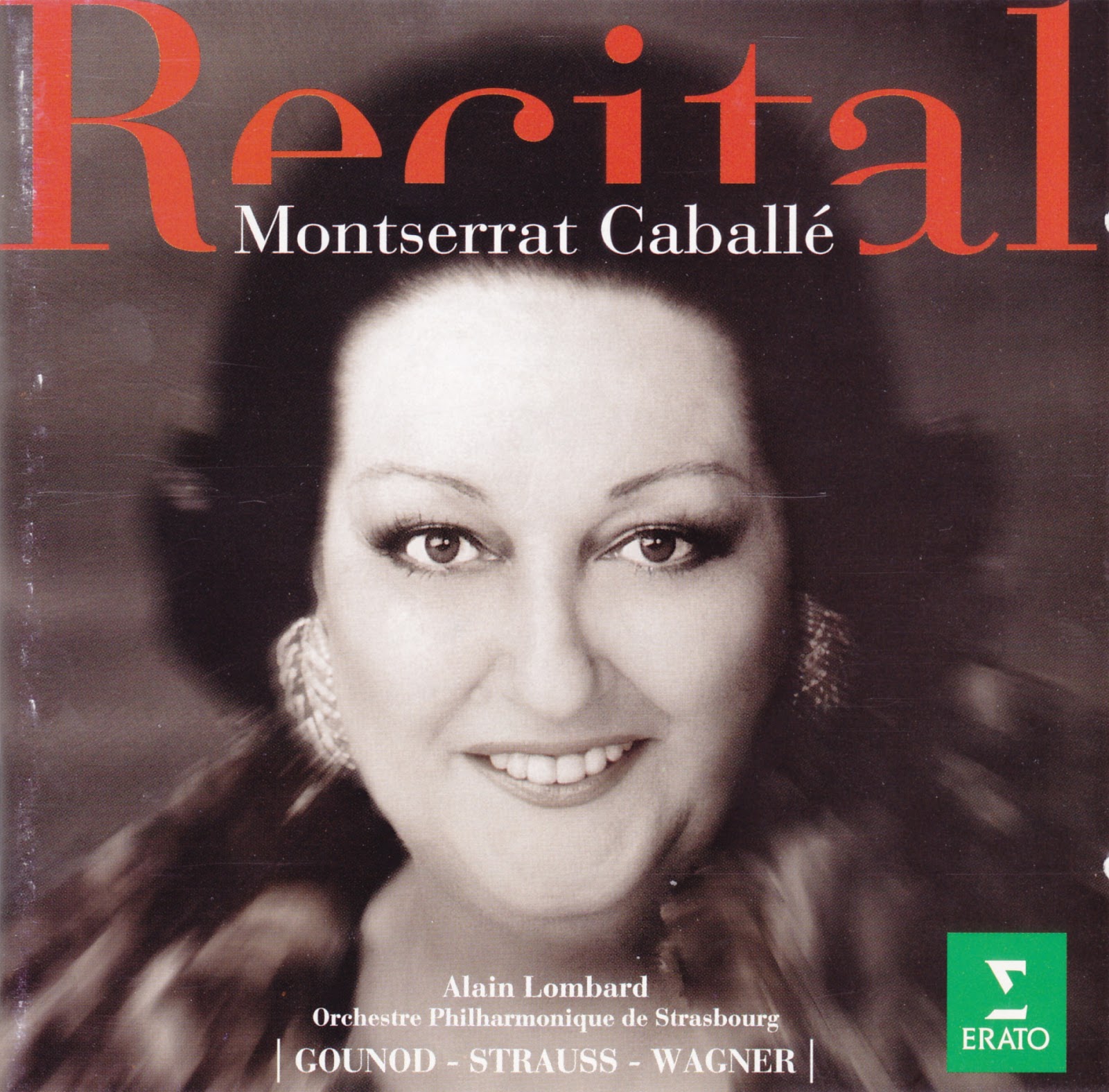
Richard Strauss / Richard Wagner / Charles Gounod - Recital


"Montserrat Caballé's career, which began with a legendary lucky break, would eventually make her one of Spain's greatest sopranos -- equaled in status and reputation only by fellow Barcelonian Victoria de los Angeles.

"Her full birth name was Maria de Montserrat Viviana Concepción Caballé i Folch. She was named after the famous Catalan monastery of Montserrat. It is said that her parents feared that they would lose her and vowed that if she were born alive and well they would christen her with the monastery's name. She learned singing at her convent school; at the age of eight, she entered the Conservatorio del Liceo in Barcelona. Her most important teachers were Eugenia Kenny, Conchita Badea, and Napoleone Annovazzi. When she graduated in 1954, she won the Liceo's Gold Medal.

"Caballé made her professional debut in Madrid in the oratorio El pesebre (The Manger) by the great Catalan cellist Pau (Pablo) Casals. She then went to Italy, where she received a few minor roles at various houses. In 1956, she joined the Basel Opera; she was working her way through the smaller roles when one of the principal singers took ill and she took over the role of Mimì in Puccini's 'La Bohéme.' Her unqualified success in that part led to promotion to starring roles, including Pamina ('The Magic Flute'), Puccini's 'Tosca', Verdi's 'Aïda', Marta in Eugene d'Albert's 'Tiefland', and the Richard Strauss roles of Arabella, Chrysothemis ('Elektra'), and Salome. She steadily gained a European reputation, singing in Bremen, Milan, Vienna, Barcelona, and Lisbon, taking such diverse roles as Violetta ('La Traviata'), Tatiana ('Yevgeny Onegin'), Dvorák's 'Armida' and 'Rusalka,' and Marie in Berg's 'Wozzeck.' She debuted at La Scala in 1960 as a Flower Maiden in 'Parsifal.' She sang in Mexico City in 1964 as Massenet's 'Manon.'

"In April 20, 1965, on extremely short notice, she substituted for the indisposed Marilyn Horne in a concert performance in Donizetti's 'Lucrezia Borgia', achieving a thunderous success and "overnight" superstardom. She became one of the leading figures in the revival of interest in the bel canto operas of Bellini and Donizetti, many of which were staged especially for her. Caballé's performances as Elizabeth I ('Roberto Devereux') and that monarch's rival Mary Queen of Scots ('Maria Stuarda') are legendary. In 1971, she sang a memorable concert performance of 'Maria Stuarda' in which her fellow Barcelonian José Carreras made his London debut, and after that she helped advance his career. She made her Metropolitan Opera debut in 1965 as Marguerite in 'Faust.' Caballé's career centered around Verdi's important dramatic roles, but also embraced the Marschallin ('Der Rosenkavalier'), the Countess ('Marriage of Figaro'), and Queen Isabella (in the premiere of Leonardo Balada's 'Cristobál Colón' in Barcelona in 1989)." (Biography by Joseph Stephenson for AllMusic. Available in full here.)

Performers: Orchestre Philharmonique de Strasbourg, Alain Lombard, Montserrat Caballé

1. Richard Strauss - Vier Letzte Lieder: Frühling
2. Richard Strauss - Vier Letzte Lieder: September
3. Richard Strauss - Vier Letzte Lieder: Beim Schlafengehen
4. Richard Strauss - Vier Letzte Lieder: Im Abendrot
5. Richard Wagner - Tristan Und Isolde: Isoldes Tod
6. Richard Wagner - Tannhäuser: 'Froh Grüß'ich Dich, Geliebter Raum!'
7. Richard Wagner - Tannhäuser: 'Almächt'ge Jungfrau-hör Mein Flehen!'
8. Charles Gounod - Faust: 'Il Était Un Roi De Thulé'
9. Charles Gounod - Faust: Récitatif
10. Charles Gounod - Faust: 'Ah! Je Ris De Me Voir Si Belle'

flac/16-bit

Friday, 8 May 2020

Richard Strauss - Vier Letzte Lieder


"Richard Strauss was a boy of six when he wrote his first song, and an old man of 84 when he completed his last. In the intervening years he made a hugely successful career as a composer of symphonies, songs and operas, a master orchestrator and conductor. But it was the marriage of music and poetry – especially with the sound of the soprano voice in mind – to which he always returned, and his gloriously serene and transcendent Four Last Songs, written a year before his death, was to be his epitaph. 

"In 1948, Strauss felt himself slowing down. There was a new world order, he was old, and he felt tainted by the tribulations of the Second World War and the unfortunate appropriation of his music by the Third Reich. His individual, lushly Romantic style of composition was increasingly seen as old-fashioned in a post-war musical world that had rejected tonality. He’d even gone as far as making the self-deprecating remark: 'I may not be a first-rate composer, but I am a first-class second-rate composer!'

"However, he was not yet ready to put down his pen – his imagination had been caught by a piece by the lyric poet Josef von Eichendorff, 'Im Abendrot' ('In the Evening Glow'), and he set to work turning it into an orchestral song. It was to be the final song in the set that became known as the 'Four Last Songs', and within five months it was followed by 'Spring', 'September' and 'Going To Sleep'. 

"Into them Strauss poured the most fundamental aspects of his musical personality – a rainbow of orchestral colour, radiant lyricism and his life-long love affair with the soprano voice. And it was as if his life had come full circle: during 'Im Abendrot', he quotes from his tone-poem 'Tod Und Verklärung' ('Death And Transfiguration'), written in his 20s. A year later, as he lay fatally ill from a series of heart attacks, he calmly claimed, 'Dying is just like I composed it in 'Tod und Verklärung'.' 

"Strauss’s last wish was that his swansong should be premiered by the Wagnerian soprano, Kirsten Flagstad. Sadly, he died eight months before his wish came true. The 'Four Last Songs' was first heard in London in May 1950, performed by Flagstad, the Philharmonia and Wilhelm Furtwängler. It is the apotheosis of Strauss’s life and work: a man who, having lived to the full, contemplates eternity with perfect equanimity." (From the Classic FM website. Link here.)

Performers: Berliner Philharmoniker, Herbert von Karajan, Anna Tomowa-Sintow

1. Vier Letzte Lieder: Frühling
2. Vier Letzte Lieder: September
3. Vier Letzte Lieder: Beim Schlafengehen
4. Vier Letzte Lieder: Im Abendrot
5. Die Heiligen Drei Konige Aus Morgenland, Op. 56 No. 6
6. Cappricio, Op. 85: Mondschein-Musik
7. Cappricio, Op. 85: Monolog Der Gräfin

flac/16-bit

Thursday, 7 May 2020

Othmar Schoeck - Notturno


"Othmar Schoeck (1886-1957) was one of a troika of Swiss composers (the others being Frank Martin and Arthur Honegger) who were instrumental in establishing Switzerland as a force to be reckoned with on the European music scene. He was born in Brunnen on the banks of Lake Lucerne, a stunning spot that in fact out-idylls just about anywhere else in the land. He studied first at the Zurich Conservatory, went to Leipzig in 1907 to spend a year writing reams of counterpoint exercises under Max Reger, then returned to Zurich, never to leave again except for concert engagements and holidays. Schoeck made his living primarily as an orchestral conductor and as a piano accompanist, but it was as a composer that he attained real significance. His oeuvre comprises eight operas, some four hundred songs, and just a few minor instrumental works. The dominance of the word in his oeuvre has not made it easy for his music to gain recognition beyond the linguistic boundaries. Even his Expressionist operatic masterpiece 'Penthesilea' (1923-5), which has enjoyed two recordings and over a dozen productions in the past quarter-century, has only once been performed outside the German-speaking world. 

"Nor is Schoeck's music always immediately easy on the ear—the idyllic was not a register he employed often. Ironically, his essentially late-Romantic style was after the Second World War nevertheless considered 'too accessible' at a time when the avant-garde was noisily sweeping all before it. Schoeck was simply a composer who managed to fall between all possible stools. But in his day, his music was admired by Alban Berg, Wilhelm Furtwängler, Paul Hindemith and many others, while his staunchest champion among performers was Dietrich Fischer-Dieskau. And if there is one work of Schoeck's to prove how well-founded was their admiration, it is surely the 'Notturno for string quartet and voice' of 1931-3. It was by no means the first-ever vocal work with string quartet accompaniment, though it is particularly remarkable for the virtuosity with which it merges vocal and instrumental forms (and is in this reminiscent of Alban Berg's opera Wozzeck, which Schoeck knew well). It was first performed on 18 May 1933 in Zurich by Felix Loeffel and the Zürcher Streichquartett. Despite its immense technical difficulties, it has proven one of Schoeck's more often-performed works — not least thanks to the persistence of Dietrich Fischer-Dieskau, who recorded it and kept it in his repertoire for over a decade. 

"The Notturno sets ten poems in five movements. The inner movements have one poem each, while the first has four, the last three. All the poems except the tenth are by the German Romantic poet Nikolaus Lenau (1802-50), one of Schoeck's favourite authors. There is no 'story' in this cycle, which is unified instead by its overall tenor of darkness (hence the title). While there is no doubt that Schoeck was troubled by the political developments to the north of the Swiss borders in the early 1930s, the dark night of the soul depicted in the 'Notturno' is in fact of purely personal origin. This is reflected in the music fabric itself by the use of a specific, recurring musical theme. It first appears in the opening movement, at the line 'Der immer naht, ihr immer doch zu fehlen' ('He approaches but never does he reach her'), then forms the basis of a subsequent sonata-form interlude for quartet alone, and returns later to dominate the final movement of the work." (Chris Walton. From the liner notes.)

Performers: Rosamunde Quartett, Christian Gerhaher

1. Notturno, Op. 47: I. Ruhig
2. Notturno, Op. 47: II. Presto
3. Notturno, Op. 47: III. Unruhig Bewegt
4. Notturno, Op. 47: IV. Ruhig Und Leise
5. Notturno, Op. 47: V. Rasch Und Kräftig (Quasi Recit.)

flac/16-bit

Sunday, 3 May 2020

Othmar Schoeck - Lieder


"'I still have a strong desire to sing his songs, even though every performance outside of Switzerland seems to meet with misunderstanding or a condescending failure of appreciation ('Helvetism', 'Provincialism').' This declaration by Dietrich Fischer-Dieskau strikes to the heart of a problem. touching on a particularly sore point. Throughout his lifetime Othmar Schoeck suffered from a diminution in stature to that of an imitator — relegated to the rank of a footnote to such earlier giants as Schumann. Brahms and Wolf. His critics looked down on him as someone who had largely failed to recognize the signs of his time or, at least, had failed to play an active pad in it. Instead, they regarded him as having his view directed backwards to the past. as being stuck in the Romantic world of 19th-century song. 

"In Fischer-Dieskau's words, the singer must 'invest more in his assignment than he can hope to effect in its external presentation'. Singing Schoeck presupposes extensive experience with Schubert, Schumann, Brahms and Wolf. but simultaneously it requires a clear understanding of early 20th-century music, with its melancholy, fin-de-siecle awareness of loss and alienation in a new world. 


"Keller's poem 'Ein Tagewerk I' ('A Day's Work I') focuses on this sense of loss: 'Jedoch mein Lied — es rang sich nicht zu Tee' ('But my song — it did not come to light'). The time is past when one could find one's song in the Romantic forests! Meyer's Reisefantasie longs for a return to the Middle Ages of castles and fortresses. For stalwart chivalry and a potent backdrop to life, instead of a weary zeitgeist that weighed down Meyer's feeling of aliveness to the point of depression. Many aspects of Schoeck reveal a spiritual affinity with this poet; or was it purely coincidental that he ended his Eichendorff cycle op. 20 with 'Nachruf' ('Obituary'), whose central strophe reads: 'Was wollen wir nun singen / hier in der Emsamkeit, / wenn alle von uns gingen, / die unser Lied ertreutl?' ('What is now the point of singing here and in solitude, when all have departed from us who took pleasure in our song?'). 

"No other interpreter could compare with Fischer-Dieskau in his ability to recapture the Romantic worlds of Eichendorff and Mörike and, simultaneously, to express the awareness of the loss of these worlds that resonates in Schoeck's lieder. Romanticism, insofar as it appears in these works as carefree happiness, is never taken by Fischer-Dieskau at face value; rather it is approached with a differentiated declamation that questions Romanticism's contradictory nature: an approach inclined to passionate outbursts, to the engagement of his whole artistic personality, to recreating emotional upheaval and blissful assuagement. The sound of his voice here takes on an unaccustomed brightness and softness, in combination with a suggestive lightness of articulation. There is nothing superficial to distract the attention — on the contrary, this is internalized singing, so to speak, that concentrates on the finest nuances of colour, on text-responsive diction, on carefully controlled vocal and verbal gestures. The sense is always perceptible behind the vocal timbre, a feeling not only for beauty or melancholy but also for its underlying poetic foundation." (Werner Pfister, tr. Richard Evidon. From the liner notes.)


Performers: Dietrich Fischer-Dieskau, Margrit Weber, Karl Engel

1. Ein Tagewerk I, Op. 55 No. 23/I
2. Ein Tagewerk I, Op. 55 No. 23/II
3. Frühgesicht, Op. 55 No. 17
4. Reisefantasie, Op. 60 No. 3
5. Das Ende Des Festes, Op. 60 No. 15
6. Nachruf, Op. 20 No. 14
7. Jugendgedenken, Op. 24b No. 10
8. Peregrina II, Op. 17 No. 4
9. Auf Ein Kind, Op. 20 No. 1
10. Dämmrung Senkte Sich, Op. 19a No. 2
11. Ach, Wie Schön, Op. 33 No. 1
12. Nachklang, Op. 19b No. 1
13. Höre Den Rat, Op. 19b No. 5
14. Venezianisches Epigramm, Op. 19b No. 13
15. Jetzt Rede Du, Op. 60 No. 28
16. Auskunft, Op. 8 No. 3
17. Aus Zwei Tälern, Op. 8 No. 2
18. Kennst Du Das Auch?, Op. 24b No. 4
19. Ravenna I, Op. 24b No. 9
20. Das Ziel, Op. 24b No. 8
21. Keine Rast, Op. 24b No. 7
22. Kindheit, Op. 31 No. 2
23. Im Kreuzgang Von Santo Stefano, Op. 31 No. 3
24. Liederzyklus, Op. 44: I. Nachtgefühl
25. Liederzyklus, Op. 44: II. Magie Der Farben
26. Liederzyklus, Op. 44: III. Verwelkende Rosen
27. Liederzyklus, Op. 44: IV. Abends
28. Liederzyklus, Op. 44: V. Mittag Im September
29. Liederzyklus, Op. 44: VI. Blauer Schmetterling
30. Liederzyklus, Op. 44: VII. Pfeifen
31. Liederzyklus, Op. 44: VIII. Sommernacht
32. Liederzyklus, Op. 44: IX. Für Ninon
33. Liederzyklus, Op. 44: X. Vergänglichkeit

flac/16-bit

Sunday, 12 April 2020

Othmar Schoeck - Elegie


"The Elegy op. 36 for baritone and chamber orchestra was created between 1921 and 1923. It is Schoeck’s first lieder cycle after he had written a great number of single lieder before. The cycle opened a new dimension of creativity to him. In it he was able to show the emotional developing process of the lyrical ego in a way that would not have been possible without the cyclic structure.

"In his Elegy Schoeck combined 24 poems by Nikolaus Lenau (18) and Joseph von Eichendorff (6), the arrangement of which re-enacted the experience of the lyrical ego from memory, like love and memory, farewell, sorrow and melancholy and loneliness, the transfiguration of pain in the face of death, and the consolation of the world. The seasons and natural phenomenons symbolically serve as an emotional reflection of the lyrical ego, as the wanderer thematic symbolizes his indefatigable longing and persuit.


"Schoeck consciously choose lyrics with a confessional character. In them he digested his own and unrequited love to a young pianist from Geneva.


"Furthermore the unity of the cycle results from its frame structure. The unforgotten love affair is embedded in a second subject area containing the existential subject of the poet, which consists of the conflict between general expectation and his own feeling and the obsession to have to write poetry. This problem can also be associated with Schoeck’s biography, which was a musical tightrope walk between tradition and modern age and the effort to maintain his point of view in a time of fast and progressive development." (Marina Staude, tr. Winfried Maas. From the liner notes.)


Performers: Mutare Ensemble, Gerhard Müller-Hornbach, Klaus Mertens

1. Wehmut
2. Liebesfrühling
3. Stille Sicherheit
4. Frage Nicht
5. Warnung Und Wunsch
6. Zweifelnder Wunsch
7. Waldllied
8. Waldgang
9. An Den Wind
10. Kommen Und Scheiden
11. Vesper
12. Herbstklage
13. Herbstgefühl
14. Nachklang
15. Herbstgefühl
16. Das Mondlicht
17. Vergangenheit
18. Waldlied
19. Herbstentschluß
20. Verlorenes Glück
21. Angedenken
22. Welke Rose
23. Dichterlos
24. Der Einsame

mp3/320kbps

Thursday, 26 March 2020

Johann Pachelbel - Un Orage d'Avril


"The pieces presented on this disc share a certain 'chamber' character, in the sense that they were surely composed for domestic use. Such is undoubtedly the case with the suites from the Musikalische Ergötzung published in 1695, where, aside from the difficulties entailed in the ‘scordatura’ writing,everything seems to indicate that they were intended for a public of sophisticated amateurs, likely toexperience great ‘musical delight’ (just as we did!) when performing this music, as the very name of thecollection suggests. The origins of the vocal pieces are less clear, and some of these arias were probablywritten for a specific purpose and for dedicatees known to a small circle of friends, such as the simplesong in praise of someone known as ‘Guter Walther’, who seems to have had a strong temperament, orthe impressive funeral laments (Mein Leben and Wie nichtig?) which are interspersed with moralisingcomments. Others seem to have a more generic meaning, in the tradition of songs to celebrate thearrival of a new season – for example Das Gewitter im Aprilen, which compares the volatility of thecapricious April climate and the constancy of friendship.

"But what links all the works on this recording, whether or not they possess a text, is their ability to conjure up painterly images. We find ourselves surrounded by sound pictures that might well have come from the golden age of Dutch and Flemish art, notably those representing episodes from everyday life. When you listen to the Aria from Partie VI or the Ballet from Partie I, don’t you have the impression that you’re in the midst of the hubbub of the folk festival depicted by Brueghel in The Peasant Wedding (and also seen in the great banquet of La Kermesse héroïque)? Don’t you get the urge to take up your lute like Jan Steen in his self-portrait and accompany yourself singing the last phrase of the Saraband from Partie VI (yes, it’s true, you have to add a text to it, but nothing could be simpler!). Listening to the Saraband of Partie III, don’t you feel the same shivers down your spine and the same doubts that seem to affect the women Vermeer painted reading their letters? And don’t the Aria of Partie V or the Gavotte of the Partie a 4 have the same half-pompous, half-comical character we find in Frans Hals’s portraits of groups of officers?
 

"All these musical miniatures float by, caressing our ears, like the light, fleeting April clouds that troop past before our eyes: all of a sudden the sky grows overcast and the stormy rain falls before finally giving way to the dazzling blue of a sunlit horizon. An ideal setting for portraits or scenes drawn from life in which those concerned must certainly have recognised themselves, and which nowadays bear precious witness to a bygone age that is still rich in emotions and lovely to behold... and listen to." (Amandine Beyer & Baldomero Barciela. tr. Charles Johnston. From the liner notes.)

Performers: Gli Incogniti, Amandine Beyer, Hans-Jörg Mammel

1. Partie V In C Major, P374: I. Sonata
2. Partie V In C Major, P374: II. Aria
3. Partie V In C Major, P374: III. Treza
4. Partie V In C Major, P374: IV. Ciacona
5. Wie Nichtig? Ach! Wie Flüchtig, P500
6. Partie II In C Minor, P371: I. Sonata
7. Partie II In C Minor, P371: II. Gavotte
8. Partie II In C Minor, P371: III. Treza
9. Partie II In C Minor, P371: IV. Aria
10. Partie II In C Minor, P371: V. Saraband
11. Partie II In C Minor, P371: VI. Gigue
12. Das Gewitter Im Aprilen, P75
13. Partie VI In B-Flat Major, P375: I. Sonata (Adagio)
14. Partie VI In B-Flat Major, P375: II. Aria
15. Partie VI In B-Flat Major, P375: III. Courant
16. Partie VI In B-Flat Major, P375: IV. Gavotte
17. Partie VI In B-Flat Major, P375: V. Saraband
18. Partie VI In B-Flat Major, P375: VI. Gigue
19. Partie A 4 In G Major, P450: I. Sonatina
20. Partie A 4 In G Major, P450: II. Allemand
21. Partie A 4 In G Major, P450: III. Gavott
22. Partie A 4 In G Major, P450: IV. Courant
23. Partie A 4 In G Major, P450: V. Aria
24. Partie A 4 In G Major, P450: VI. Saraband
25. Partie A 4 In G Major, P450: VII. Gigue
26. Partie A 4 In G Major, P450: VIII. Finale. Adagio
27. Mein Leben, Dessen Creutz Für Mich, P360
28. Partie III In E-Flat Major, P372: I. Sonata (Allegro)
29. Partie III In E-Flat Major, P372: II. Allemand
30. Partie III In E-Flat Major, P372: III. Courant
31. Partie III In E-Flat Major, P372: IV. Gavotte
32. Partie III In E-Flat Major, P372: V. Saraband
33. Partie III In E-Flat Major, P372: VI. Gigue
34. Partie IV In E Minor, P373: I. Sonata
35. Partie IV In E Minor, P373: II. Aria
36. Partie IV In E Minor, P373: III. Courant
37. Partie IV In E Minor, P373: IV. Aria
38. Partie IV In E Minor, P373: V. Ciacona
39. Guter Walther Unser Raths, P180
40. Partie I In F Major, P370a: I. Sonata (Allegro)
41. Partie I In F Major, P370a: II. Allemand
42. Partie I In F Major, P370a: III. Courant
43. Partie I In F Major, P370a: IV. Ballet
44. Partie I In F Major, P370a: V. Saraband
45. Partie I In F Major, P370a: VI. Gigue
46. O Großes Musenliecht, P391
47. Canon & Gigue, P37: I. Canon
48. Canon & Gigue, P37: II. Gigue

mp3/320kbps

Wednesday, 25 March 2020

Charles Koechlin - Le Cortege d'Amphitrite


"Koechlin was a late developer as a composer and needed the inspiration of poets early on in his career. Until he felt ready to enter the 'perilous domain of chamber music' around 1911, his first period was dominated by songs and choral music, and his harmonic evolution can be traced through this medium from relatively ordinary beginnings around 1890 to the polytonality of the 1905-9 songs (Opp 28, 31 and 35) that impressed and influenced Milhaud.

"[...] In 'Le Printemps', with its light evocative trills, Koechlin maintained that it was 'a Parisian girl who was singing and it was her feelings that I sought to express', whereas Miss Ellen in Le Thé (with her elaborately decorated Chinese teacup) was a young French girl Koechlin saw on holiday in Switzerland." (Robert Orledge. From the liner notes.)


Performers: Claudette Leblanc, Boaz Sharon

1. Si Tu Le Veux, Op. 5 No. 5
2. 7 Chansons Pour Gladys, Op. 151: I. M'a Dit Amour
3. 7 Chansons Pour Gladys, Op. 151: II. Tu Croyais Le Tenir
4. 7 Chansons Pour Gladys, Op. 151: III. Prise Au Piège
5. 7 Chansons Pour Gladys, Op. 151: IV. La Naïade
6. 7 Chansons Pour Gladys, Op. 151: V. Le Cyclone
7. 7 Chansons Pour Gladys, Op. 151: VI. La Colombe
8. 7 Chansons Pour Gladys, Op. 151: VII. Fatum
9. Le Cortège d'Amphitrite, Op. 31 No. 2
10. Amphise & Melitta, Op. 31 No. 6
11. Déclin D'amour, Op. 13 No. 1
12. Aux Temps Des Fées, Op. 7 No. 4
13. Le Repas Préparé, Op. 31 No. 5
14. La Chanson Des Ingénues, Op. 22 No. 1
15. Améthyste, Op. 35 No. 2
16. Hymne À Vénus, Op. 68 No. 1
17. L'Hiver, Op. 8 No. 2
18. La Nuit, Op. 1 No. 2
19. L'Été, Op. 1 No. 5
20. L'Air, Op. 8 No. 5
21. La Lune, Op. 8 No. 4
22. Le Printemps, Op. 1 No. 4
23. Le Thé, Op. 1 No. 3

mp3, 320kbps